
The Best Natural, Petroleum-Free Alternatives to Vaseline: What Actually Works?
Oct 01, 2026
For decades, Vaseline® (petroleum jelly) has been considered one of the most effective products for protecting dry, damaged skin. Pediatric dermatologists often recommend it for eczema because it creates a strong barrier that helps reduce moisture loss.
But not every family wants to use it.
Some parents simply don’t like the greasy feel. Others find it seems to trap heat or make their child’s skin feel itchier. And many are looking for petroleum-free alternatives because petroleum jelly is made from petroleum—a fossil fuel derivative.
So the question becomes:
Can natural products do the same job?
The answer is yes…and no.
Many natural ingredients can be excellent moisturizers, but very few function exactly like petroleum jelly. Understanding the difference is one of the most important things parents can learn when choosing products for eczema-prone skin.
Why Some Families Avoid Petroleum Jelly
Petroleum jelly is made from highly refined petroleum, a byproduct of crude oil refining. Although cosmetic-grade petroleum jelly undergoes extensive purification and is considered safe by major health organizations when properly refined, some families still choose to avoid it.
Common reasons include:
- They prefer plant-based or naturally derived ingredients.
- They want to reduce their use of fossil-fuel-derived products.
- They prefer more environmentally renewable ingredients.
- They dislike the greasy texture.
- They feel it traps heat or sweat on their child’s skin.
- They notice their child’s skin seems itchier after applying it.
It’s also worth noting that petroleum jelly is an extremely common ingredient in modern skincare, makeup, baby products, and cosmetics. It has been used in personal care products for decades because it is inexpensive, stable, and highly effective at reducing moisture loss.
It’s important to recognize that these are preference-based reasons, not evidence that properly refined petroleum jelly is harmful when used as directed. Cosmetic-grade petroleum jelly has a long history of safe use.
Why Vaseline Works So Well
To understand why replacing Vaseline isn’t always straightforward, it helps to know what it actually does.
Vaseline is an occlusive.
An occlusive sits on top of the skin and dramatically slows transepidermal water loss (TEWL)—the natural evaporation of water from the skin.
Think of it like placing a lid over a pot of water.
The water doesn’t disappear—it stays where you want it.
This is especially helpful after bathing because the skin contains its highest amount of water immediately after getting wet.
Petroleum jelly excels at one job:
Keeping water from escaping.
It doesn’t hydrate the skin itself.
It simply helps the skin hold onto the hydration it already has.
Research has consistently shown that petroleum jelly is one of the most effective ingredients available for reducing transepidermal water loss, which is why it has remained a mainstay in dermatology despite the availability of many newer products.
The Three Types of Moisturizers
Not all moisturizers work the same way.
Most products fall into one (or more) of these categories:
Occlusives
Create a barrier that slows water loss.
Examples:
- Petroleum jelly
- Mineral oil
- Beeswax
- Lanolin
- Dimethicone
Emollients
Smooth rough skin by filling tiny gaps between skin cells.
Examples:
- Shea butter
- Cocoa butter
- Tallow
- Jojoba oil
Humectants
Pull water toward the skin.
Examples:
- Glycerin
- Hyaluronic acid
- Urea
Many eczema products combine all three.
Why Natural Alternatives Don’t Always Feel the Same
Parents often assume any thick balm will work like Vaseline.
Not necessarily.
A product can feel thick while still allowing significantly more water to evaporate.
That’s because ingredients behave differently.
For example:
- Shea butter softens skin beautifully but doesn’t form as complete a moisture barrier.
- Coconut oil nourishes skin but isn’t nearly as occlusive.
- Jojoba oil absorbs into the skin instead of sitting on top of it.
- Beeswax creates more of a protective film than plant oils alone.
So if your goal is locking in hydration after a bath, the strongest natural substitute is usually not a plain oil.
The Best Petroleum-Free Alternatives
1. Squalane
Best for: Everyday full-body moisturizing.
Squalane is a plant-derived lipid, most commonly sourced from olives or sugarcane, that closely resembles the skin’s own natural oils. Unlike heavy ointments, it absorbs quickly without leaving behind a greasy or sticky residue.
Because it spreads easily and doesn’t stain clothing, many parents find it ideal for moisturizing large areas of a toddler’s body.
Pros
- Lightweight
- Non-greasy
- Plant-derived
- Very low allergy risk
- Excellent for daily moisturizing
Cons
- Doesn’t provide as strong a moisture seal as petroleum jelly
- May not be sufficient alone during severe eczema flares
2. Wax-Based Balms (Closest to Vaseline)
Best for: Parents wanting the closest petroleum-free replacement.
These products combine beeswax with nourishing oils to imitate the thick, protective feel of petroleum jelly.
Examples include:
- Sky Organics Petroleum-Free Jelly
- Beesaluxe Original Unpetroleum
These formulas don’t create quite as complete a moisture seal as petroleum jelly, but they’re among the closest natural alternatives available.
Pros
- Thick protective barrier
- Long-lasting
- Great for dry patches
- Excellent for lips and hands
Cons
- Still slightly less occlusive than petroleum jelly
- Can feel sticky
3. Mineral Oil
Mineral oil is closely related to petroleum jelly. Both are highly refined petroleum (fossil fuel) derivatives and are widely used throughout the skincare and cosmetics industry because they’re stable, inexpensive, and excellent at reducing moisture loss.
Mineral oil forms a protective barrier on the skin and reduces moisture loss, although it is generally lighter and less occlusive than petroleum jelly.
However, because mineral oil is also a petroleum-derived ingredient, it would not be considered a petroleum-free alternative. For families specifically trying to avoid petroleum-based ingredients, mineral oil isn’t the replacement they’re looking for.
Pros
- Excellent moisture barrier
- Less greasy than petroleum jelly
- Widely available
Cons
- Not petroleum-free
- Slightly less occlusive than petroleum jelly
4. Grass-Fed Beef Tallow
Best for: Very dry skin and families who prefer animal-based skincare.
Tallow has become increasingly popular because its fatty acid profile resembles many of the lipids naturally found in human skin.
Many parents find it absorbs more readily than petroleum jelly while still leaving behind a protective layer.
However, it’s important to distinguish between traditional use and scientific evidence. While tallow is an effective emollient, there is limited clinical research comparing it with standard eczema treatments.
Pros
- Rich in skin-friendly fatty acids
- Deeply moisturizing
- Often well tolerated
Cons
- Doesn’t have the same moisture-sealing ability as petroleum jelly
- Product quality varies widely
5. Shea Butter
Best for: Daily dry skin maintenance.
Raw shea butter contains natural fatty acids that soften rough skin and provide moderate barrier protection.
Many families love it because it feels rich without being quite as greasy.
Pros
- Excellent moisturizer
- Plant-based
- Rich in beneficial lipids
Cons
- Doesn’t seal water as effectively as petroleum jelly
6. Cocoa Butter
Cocoa butter behaves similarly to shea butter.
It’s rich, nourishing, and creates a protective layer over dry skin.
However, it functions more as an emollient than a powerful occlusive.
7. Jojoba Oil
Jojoba oil is unique because its structure closely resembles human sebum.
Instead of sitting heavily on the surface, it tends to absorb into the outer layers of skin.
This makes it excellent for softening skin but less effective at preventing water evaporation.
For some children with eczema, especially those who dislike heavy ointments, jojoba oil can be a comfortable option.
8. Coconut Oil
Virgin coconut oil has been studied more than many other natural oils for eczema.
Some research suggests it may help reduce Staphylococcus aureus bacteria on the skin while also moisturizing.
However, it still doesn’t replace the moisture-sealing ability of petroleum jelly.
It’s also important to know that although coconut oil is well tolerated by many people, it can cause irritation or allergic reactions in some individuals. As with any new skincare product, it’s best to patch test first.
9. Lanolin
Lanolin is a natural wax derived from sheep’s wool and is an excellent occlusive that helps reduce moisture loss. It has long been used in healing ointments and lip balms because of its protective properties.
Lanolin is capable of absorbing significant amounts of water while helping create a protective barrier on the skin, making it one of the closest natural alternatives to petroleum jelly in terms of barrier protection.
However, lanolin allergy is well documented, particularly in people with eczema or chronic skin barrier damage. If a child has a lanolin sensitivity, products containing it may worsen irritation instead of helping.
One example is Aquaphor Healing Ointment, which contains both petrolatum (petroleum jelly) and lanolin alcohol. While many families love Aquaphor, it isn’t petroleum-free and may not be the best choice for someone with a lanolin allergy or sensitivity.
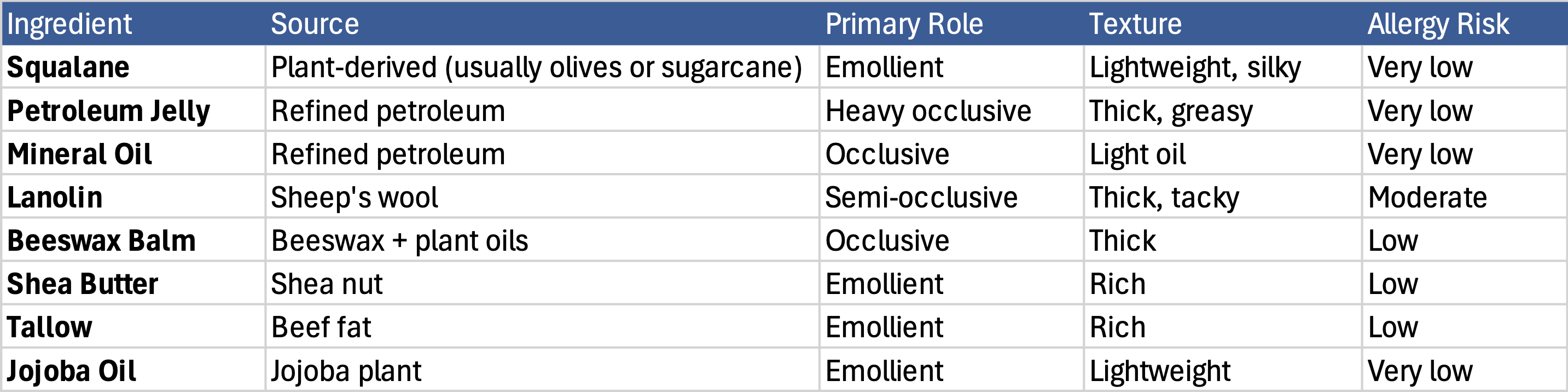
Vaseline Alternatives: Side-by-Side Comparison
Which One Is Best?
The answer depends on what you’re trying to accomplish.
If your goal is…
Maximum moisture sealing
→ Petroleum jelly still performs best.
Closest natural replacement
→ Beeswax-based balm.
Deep nourishment
→ Shea butter or tallow.
Lightweight daily moisture
→ Jojoba oil.
Simple natural oil
→ Coconut oil (if well tolerated).
One Final Thought
One of the biggest misconceptions in eczema care is believing that every moisturizer does the same thing.
They don’t.
Some products seal moisture.
Some soften skin.
Some draw water into the skin.
Many do a little of each.
That’s why one child may do beautifully with jojoba oil, while another needs a heavier beeswax balm—and another still may respond best to petroleum jelly.
Rather than asking, “Which product is best?” a better question is:
“What does my child’s skin need right now?”
No single ingredient is right for every child or every stage of eczema. The goal isn't to find one "perfect" product—it's to understand what each ingredient does so you can choose the one that best supports your child's skin in that moment.