
Why Your Child Scratches More After Eating (It's Not Always a Food Allergy)
Jul 04, 2026
You notice it every time.
Your child eats, and within minutes — or an hour later — the scratching starts.
It's natural to assume a food allergy. But in many cases, what's happening has nothing to do with true immunological food sensitivity.
Understanding the difference can save families months of unnecessary elimination diets — and a lot of stress.
In fact, most post-meal itching in children with eczema is not a true food allergy.
True Food Allergy vs. Eczema Trigger: Not the Same Thing
A true food allergy involves the immune system (IgE-mediated response). It typically causes:
- Hives, swelling, or vomiting within minutes
- Consistent reactions to the same food every time
- Potentially serious symptoms
A food-related eczema flare is different. It's often:
- Delayed (hours, not minutes)
- Inconsistent — the same food doesn't always cause it
- Driven by non-immunological factors
Most post-meal scratching in eczema children falls into the second category.
4 Reasons Eczema Flares After Meals (That Aren't Allergies)
1. Heat and Increased Blood Flow
Eating raises core body temperature. For eczema-prone skin with sensitized nerve endings, even a small rise in skin temperature can trigger itching.
This is especially noticeable after:
- Hot foods
- Soups or warm meals
- Active eating (running around afterward)
2. Saliva Contact
Saliva is one of the most irritating substances for eczema-prone skin around the face and mouth.
During meals, saliva contacts:
- Lips and corners of the mouth
- Chin
- Cheeks (in younger toddlers)
The result often looks like a food reaction but is actually a contact irritant response — not an allergy.
3. Histamine-Rich Foods
Some foods are naturally high in histamine or trigger histamine release — without involving an IgE allergy response.
Common examples include:
- Tomatoes and tomato-based products (including tomato sauce)
- Strawberries
- Citrus fruits (such as oranges, lemons, and limes)
- Aged cheeses (such as cheddar, parmesan, and blue cheese)
- Fermented foods (such as sauerkraut, kimchi, kefir, and kombucha)
- Processed and cured meats (such as salami, pepperoni, ham, and bacon)
- Smoked or canned fish (such as tuna, sardines, and mackerel)
- Vinegar and foods containing vinegar (including some pickles and dressings)
This can cause flushing, itching, or skin reactivity in histamine-sensitive children.
It's important to remember that these foods aren't "bad" or guaranteed to worsen eczema. Most children with eczema can eat them without any problems. Histamine sensitivity varies from person to person, so any connection should be based on consistent patterns rather than a single meal.
4. Trigger Stacking
A meal often comes with several simultaneous factors:
- Heat from the food
- Saliva exposure
- Excitement or physical activity
- Friction from a bib or chair
Any one of these might be tolerable. Together, they can push reactive skin past its threshold.
Other common “stackers” that can add to the itch load the same day include illness, poor sleep, teething/drool, dry air, sweat/overheating, irritating fabrics (rough seams, scratchy knits, tight collars, or heat-trapping synthetics like polyester for some kids), fragranced products, and seasonal allergies.
How to Tell the Difference
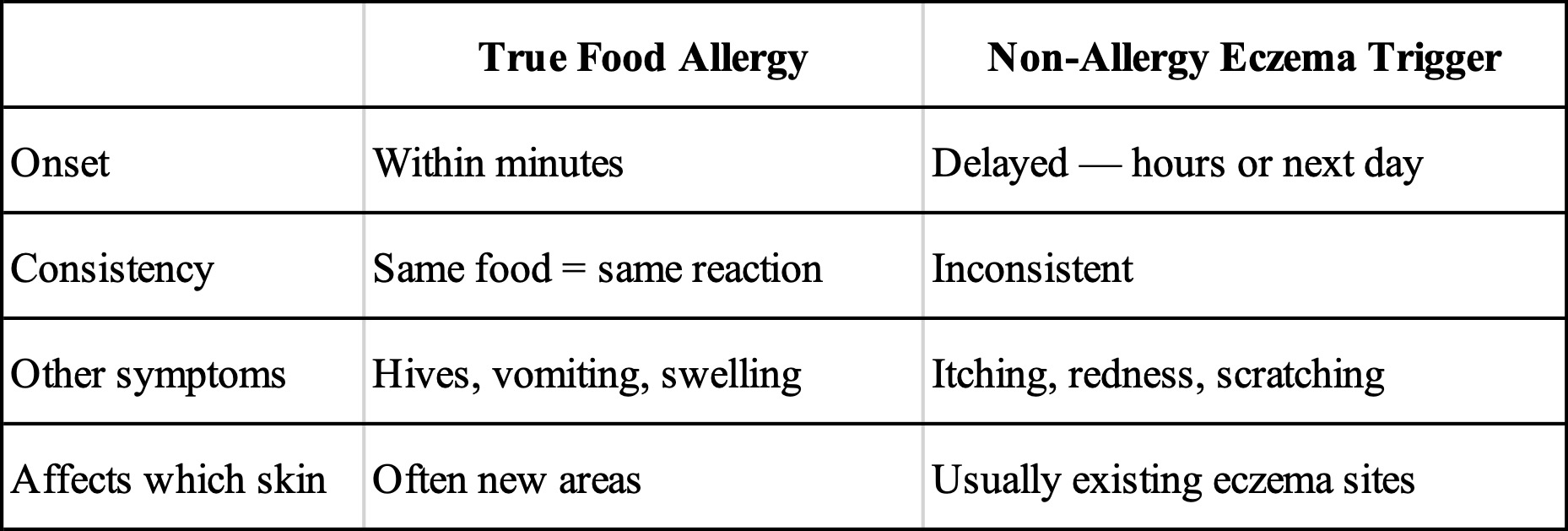
If reactions are delayed and inconsistent, elimination diets are unlikely to help and worth questioning.
When Elimination Diets Make Sense (and When They Don't)
Sometimes food can be a contributing trigger for eczema flares (even when it isn’t a true IgE-mediated allergy). Common culprits families hear about most often include:
- Dairy
- Eggs
- Wheat / gluten
- Soy
- Corn
- Citrus
- Tree nuts
An elimination approach can be useful, but it works best when it’s structured and not overly restrictive.
Consider allergy testing when:
- Reactions are immediate and consistent
- There are non-skin symptoms (vomiting, swelling, breathing changes)
- Your pediatrician or allergist recommends it
If trying an elimination diet, keep it simple (the “4-week, one-change” rule):
- Pick one suspected food at a time (to isolate variables).
- Remove it strictly for 4 weeks and monitor skin changes (and itching, sleep, stool, etc.).
- Reintroduce it on its own, in a meaningful amount, to get a clear signal.
- After reintroduction, avoid introducing other new foods for 3–4 days, since some reactions can be delayed 24–48 hours.
Be cautious about self-directed elimination when:
- Reactions are delayed and inconsistent with no clear pattern
- Multiple foods are removed at once (it becomes impossible to know what mattered)
- The child is already on a restricted diet
Unnecessary food elimination can create nutritional gaps — particularly in babies and toddlers — without improving eczema.
Practical Strategies for Post-Meal Scratching
- Wipe face and hands gently during and after meals to minimize saliva and food contact
- Use a simple skin barrier around the mouth when needed — a thin layer of petroleum jelly (like Vaseline) or a balm can help protect eczema-prone skin from saliva, drool, and messy foods.
- Cool the skin after eating if flushing or heat seems to trigger scratching
- Keep a simple log — note what was eaten, the temperature of the food, and other context (illness, activity, sleep) to identify patterns
- Ask your pediatrician about antihistamines when itching disrupts sleep — for some children, environmental allergies can amplify itching, and a clinician may recommend an age-appropriate option (for example cetirizine/Zyrtec or similar). Always follow your pediatrician’s dosing guidance.
- If histamine seems to be a factor, focus on “histamine load,” not perfection — this doesn’t have to mean never having histamine-related foods. It can mean avoiding stacking several higher-histamine foods in the same day. For example, offering a small amount of banana one day, then waiting a few days before trying avocado or strawberries, rather than doing banana + avocado + strawberries together.
- Reduce ultra-processed foods and refined sugar when possible — packaged/boxed foods can make it harder to pinpoint triggers and may contribute to more overall inflammation for some kids.
- Support gut health with “real food” basics — the gut is one of the body’s largest immune sites (often summarized as ~70% of immune cells being associated with mucosal tissues like the gut). A fiber-rich, minimally processed diet can help support a healthy microbiome.
- Consider targeted nutrition support with a clinician — depending on age and medical history, some families discuss omega-3s, zinc, vitamin D/other vitamins, probiotics, or L-glutamine with their pediatrician/dietitian.
- Talk to your pediatrician before eliminating major food groups or starting supplements
Final Takeaway
Post-meal scratching is frustrating — but it's often not what it looks like.
Before eliminating foods, consider heat, saliva, histamine sensitivity, and trigger stacking. These non-allergy mechanisms are more common than most parents realize, and addressing them is often simpler than overhauling your child's diet.
Medical References
- American Academy of Pediatrics — Food allergy and atopic dermatitis
- National Eczema Association — Food and eczema
- Journal of Allergy and Clinical Immunology — histamine and atopic dermatitis